
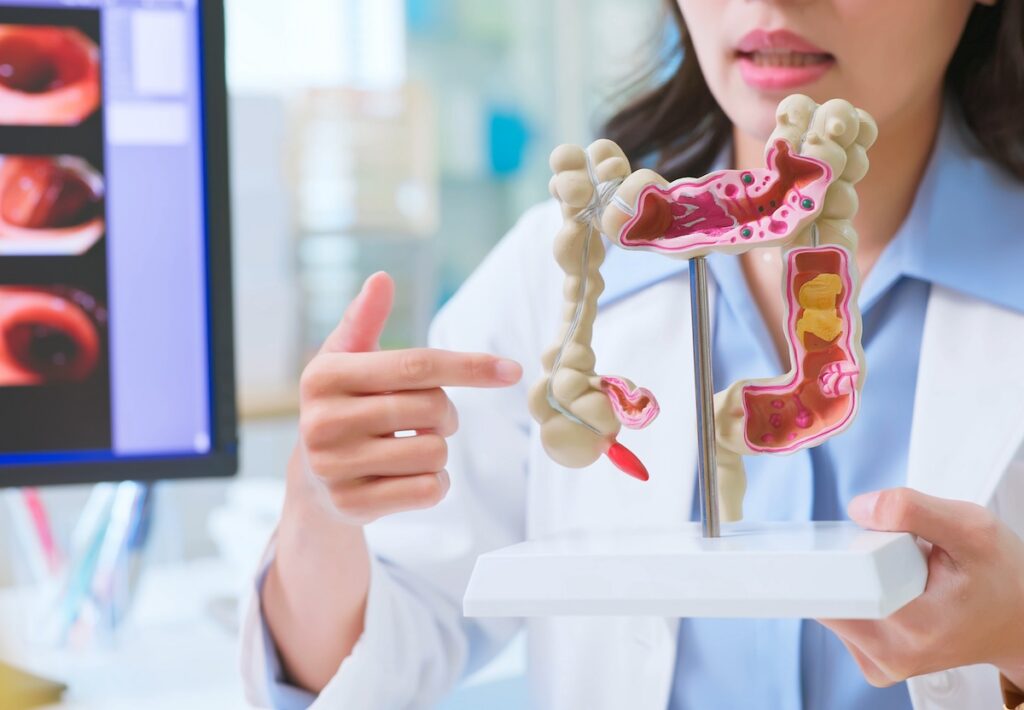
Colon cancer, or colorectal cancer, is a serious but often highly treatable disease when it’s detected early. But outcomes depend heavily on timely screening, accurate staging, and a well-coordinated treatment plan – and that’s where TopLine MD Alliance Network specialists come in.
Colorectal cancer typically begins as small growths (polyps) in the colon or rectum that can slowly develop into cancer over time. Because early colorectal cancer often has few symptoms, or none at all, many cases are only identified through routine screening – making prevention and early detection a central part of care rather than just a diagnostic step.
Staging also plays a critical role in shaping a patient’s treatment plan, ranging from Stage 0 confined to the inner lining of the colon to Stage IV where cancer has spread to distant organs, such as the liver or lungs. Early-stage cases may be treated primarily with surgical removal of the polyp(s) or affected portion of the colon, while more advanced stages often require a combination of colorectal surgery, chemotherapy, radiation, immunotherapy, and/or targeted therapy.
Connecting Florida patients to colorectal cancer care
In Florida and across the United States, colorectal cancer care is managed through a combination of primary care physicians, gastroenterologists, and colorectal surgery specialists, often within integrated health systems and surgical networks.
Care delivery through the TopLine MD Alliance is highly coordinated, involving colorectal surgeons, oncologists, and surgical teams working together to determine the most effective approach. Facilities like those within Jackson Health System and leading academic medical centers such as Mayo Clinic and Cleveland Clinic emphasize multidisciplinary evaluation, surgical precision, and continuity of care through treatment and recovery.
Within this landscape, the TopLine MD Alliance connects patients to trusted, high-quality specialists across gastroenterology, oncology, and colorectal surgery, helping to streamline referrals and reduce delays in diagnosis and treatment. This type of networked care can be especially important when time-sensitive evaluations or specialist input are needed, ensuring that Florida colorectal cancer patients move more efficiently from symptom evaluation to diagnosis to treatment.
Preparation and education are equally important. Patients who understand the diagnostic process, colon cancer staging implications, and treatment pathway tend to be better equipped to navigate decisions, manage recovery expectations, and stay engaged in follow-up care – all of which can significantly influence outcomes.
Keep reading to learn more about the role that TopLine MD Alliance Network specialists play in preventive gastrointestinal healthcare and colorectal cancer treatment. We’ll also address common patient questions and misconceptions about colon cancer, including early warning signs, colonoscopy screening, biopsy results, and more.
Colon cancer may not cause symptoms at first
Colon cancer develops very slowly. In fact, it takes about 10 years for a precancerous polyp to turn into a cancerous polyp that may cause symptoms.
Most patients initially present with vague symptoms, such as:
- Abdominal pain or discomfort
- Changes in bowel habits, such as constipation or diarrhea
- Unexplained weight loss
- Rectal bleeding
- Feeling tired or weak
Conditions like stomach flu or food poisoning can also cause abdominal pain or discomfort, constipation, or diarrhea – reach out to a health provider if these symptoms last more than a few days. You should reach out right away for unexplained weight loss, rectal bleeding, or feeling tired or weak, especially if you are getting enough rest.
Once colon cancer is suspected, diagnosis will be confirmed through colonoscopy and biopsy, followed by imaging to determine how far the disease has progressed. Many patients are asymptomatic (meaning they have no symptoms) until the later stages, making routine screening even more critical.
Detecting colon cancer as early as possible
Colon cancer is the second deadliest cancer in the United States, with an estimated 55,000+ deaths expected this year, and the leading cause of cancer-related death in young adults.
But colon cancer is also one of the few cancers that can be both prevented and cured when caught early. Routine screening allows health providers to find and remove precancerous polyps before they turn into cancer and detect tumors at their earliest stages, when treatment is most effective. Early-stage colon cancer has up to a 90% cure rate – but screening is the only way to catch it before it spreads.
Due to the rise of colon cancer in young adults, medical guidelines now recommend that men and women of average risk begin routine colorectal screenings at age 45. Colonoscopies are typically performed every 5-10 years, based on the patient’s health risks, history, and other factors.
Diagnosing colon cancer
If you are experiencing colon cancer symptoms or your health provider suspects you might have colon cancer, the next step is diagnosis. Your health provider will ask about your symptoms and may examine your abdominal area for masses or organs that are larger than normal.
To confirm a colon cancer diagnosis, they may also perform the following tests:
- Blood tests, including a complete blood count (CBC) or complete metabolic panel (CMP)
- Imaging tests, such as CT scans, MRI scans, or ultrasounds
- Diagnostic colonoscopy, which uses a small, flexible camera to examine the lining of your colon and/or rectum
- Biopsy, which examines a tissue sample from the colon and/or rectum by microscope to check for precancerous or cancerous cells
These tests do more than diagnose colon cancer. They also help your colorectal care team identify your cancer stage, which impacts your prognosis and treatment plan.
The stages of colon cancer and what they mean
Colon cancer stages describe the size and spread of the precancerous or cancerous growth(s) and are used to determine your treatment plan option and survival outlook – the lower the stage number, the better.
Stage 0 – Abnormal or precancerous cells found in colon polyp(s)
Stage I – Cancerous polyp(s) in your colon wall
Stage II – This stage has three substages:
- Stage IIA – Cancer has spread through most of your colon wall but not into the wall’s outer layer
- Stage IIB – Cancer has spread through most of the outer layer of your colon wall
- Stage IIC – Cancer has spread through your colon wall but not to your lymph nodes
Stage III – Cancer has spread through your colon wall to nearby lymph nodes
Stage IV – Cancer has spread to other, more distant areas of your body, such as lymph nodes that are far from your colon or your liver or lungs
Treating early-stage colon cancer
Colorectal surgery is the most common treatment for colon cancer that has not spread to the lymph nodes or other organs. For instance, your health provider may recommend:
- Polypectomy – A minimally invasive procedure that removes precancerous or cancerous polyps in your colon, often during a routine screening like a colonoscopy
- Colectomy – A surgical procedure that removes part or all of the colon, along with nearby lymph nodes if necessary
Colorectal surgery includes a wide range of surgical procedures that can treat conditions affecting the lower digestive tract, including the colon, rectum, anus, pelvic floor, and small intestine. Many procedures can be performed using minimally invasive techniques, such as laparoscopic or robotic surgery.
During these procedures, the surgeon makes a few small incisions into the abdominal wall, using a tiny camera and specialized tools. Minimally invasive procedures typically result in faster recovery, less pain, and smaller scars. A more complex colectomy may require open surgery, where the surgeon makes one long incision into the abdomen.
After the damaged section of the colon is removed, the surgeon must reconnect the digestive tract to allow for normal passage of stool. If a complete reconnection is not immediately possible, a colostomy (an external, odor-proof pouch that collects waste) may be required – however, this is rare.
The surgical removal of part or all of the colon is also referred to as a bowel operation, bowel surgery, or bowel resection. In addition to colon cancer, colorectal surgery is used to treat inflammatory bowel disease (such as Crohn’s disease or ulcerative colitis), diverticulitis, and even hemorrhoids.
Treating late-stage colon cancer
Surgery for colon cancer that has spread to other areas of the body usually aims to remove the cancer, relieve the patient’s symptoms, and extend their life as much as possible.
In addition to a colectomy, the patient may need a metastectomy, a surgical procedure that removes metastatic tumors in other organs where colon cancer most commonly spreads (such as the liver or lungs).
A multivisceral resection is another complex surgery used when colon cancer has grown into nearby organs. In addition to removing the original tumor, the surgeon may remove affected sections of the uterus, bladder, or other pelvic organs.
Before and after surgery, the patient may require additional treatment, such as chemotherapy, radiation, immunotherapy, and/or targeted therapy.
Expert colorectal cancer care in Florida
The TopLine MD Alliance was created by physicians who came together to make healthcare experiences better for patients. We help patients navigate the complex healthcare system, connecting them with top-tier healthcare providers, practices, diagnostic centers, and imaging centers we trust.
From primary care physicians to colorectal surgery specialists, you can count on TopLine MD Alliance Network providers to keep you on track with colon cancer screenings and guide you throughout your cancer journey. To learn more, find a provider today.